Wednesday, November 28, 2007

Consider an Overseas Service-Learning Experience


The Toronto Catholic District School Board, in partnership with Free the Children, offers overseas service learning opportunities for senior high students. These groups are open to students in public and other schools as well. Students raise funds for their trip and are sometimes helped through scholarships. For more information, contact Greg Rogers at: gregory.rogers@tcdsb.org

Students on a three-week summer experience helping to build a school and to teach the children, Kenya. Many other similar service learning programs exist. Consider applying for a cross-cultural experience that will truly expand your horizons! Students say such trips open their eyes to what is most important in life:
• new understanding
• new friends
• new leadership skills
• greater self-confidence
and much much more!

L'Arche Around the World


Consider spending a “Gap” year in a L’Arche Community


L’Arche welcomes many high school graduates and university students as live-in assistants. Spending a year as a L’Arche assistant is a wonderful opportunity to learn, to grow and to discover your gifts, to make new friends, to serve, to make a difference in the lives of others, and to help change our world. For more information and an application go to: www.larche-work.ca

Tuesday, November 27, 2007

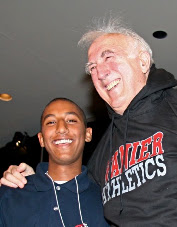
Pictures from the Jean Vanier Youth Forum

photos courtesy of W.P Whittman Photography


More Pictures from the Vanier Youth Forum

photos courtesy of W.P Whittman Photography


Take the survey

Have you used the "Choosing Our Future" video and audio material in your school. If you have we would like you to take a survey. It will take you less than 10 minutes.

If you are a student GO HERE.

If you are a teacher GO HERE

Vanier: 'Close to a saint'

photos courtesy of Boris Hoffman


The founder of L'Arche has spent nearly a lifetime championing the severely disabled
Charles Lewis, National Post
Published: Saturday, November 03, 2007

Imagine a hotel ballroom so big it is difficult to see from one end to the other. Imagine it filled with 2,000 folding chairs and sitting on those folding chairs are 2,000 high school students from all over Ontario. All have awoken early, piled into school buses and then been shipped to a bleak commercial strip on the edge of Toronto. Now imagine keeping their attention while delivering a message about gentleness, love and community and how the mentally and physically disabled can be a door to salvation.

The man who is to speak to them, Jean Vanier, is a lanky 6-foot-4, and at 79 years old slightly stooped. The serenity in his face seems to radiate out through the fine white hair on top of his head. He has spent most of his life telling people that by tending to society's weakest it can transform humanity

As he takes the stage, the sea of teenage hormones is stilled. He half sits, half leans against a table and begins to speak in a voice so soft and measured it envelopes. He makes no attempt to prove he is tuned in to teenage culture. But his message is subversive.

"Weakness becomes our strength. Because when I say I'm weak, I say I need you. Weakness can be beautiful because it can bring us together in community," he tells them. He challenges them to eschew what everyone else does --making money and climbing the ladder of promotion.


"The sign of being human is to be a friend to the weak person. There's something in the history of humanity that shows being human is to care for the weak -- the fragile, the orphans and the widow."

It is the philosophy behind his work as a founder of L'Arche (the Ark), communities around the world for severely disabled people -- work that has earned him a Companion of the Order of Canada and a Nobel Peace Prize nomination. The first L'Arche was a single home for just two mentally disabled men; there are now 130 such communities around the world for about 2,500 people with all sorts of disabilities -- people who might have otherwise been left in grim institutions or gone begging.

Mr. Vanier founded L'Arche more than 40 years ago in the small French town Trosly, where he lives to this day and from where he travels the world spreading an interpretation of the Gospels that demands engaging society's discards.

He has written many books -- Befriending the Stranger, Drawn into the Mystery of Jesus through the Gospel of John and his most secular book, Becoming Human. He has just released Our Life Together -- A Memoir in Letters, which traces the history of L'Arche and his extensive travels through a series of letters to colleagues and friends. It will likely be his last book and will stand as part of his final legacy. He has even begun contemplating how L'Arche till transform "from the oneness to the group" once he passes on. But there is little sign of him slowing. Over five days he took part in a two-day conference with high school teachers and students in Toronto, flew to Washington for a meeting with theologians, and then back to Toronto, en route to France, for a few hours to promote Our Life Together.

All this to spread a singular message of compassion.

In the introduction to Our Life Together he writes: "[We] see the face of God within the disabled. Their presence is a sign of God, who has chosen [quoting St. Paul] 'the foolish in order to confound the strong, the proud and the so-called wise of our world.' And so those we see as weak or marginalized are, in fact, the most worthy and powerful among us: they bring us closer to God."

Many of the people who live in L'Arche cannot speak, see or hear; many need help with the most basic human functions. Those who have travelled to his L'Arche homes, whether in Honduras, the Ivory Coast, or Canada, say you always find a similar spirit of communion in each. The paid assistants live with those who are disabled as a family. Every effort is made to live as true equals.

In Toronto, I met a man at a L'Arche home who had been found in an institution more than 20 years ago. This man, who is lovely and friendly but is physically deformed and mentally challenged, holds down a job cleaning at a supermarket. One of his house-mates is in a wheelchair; she cannot speak, her body is in constant spasms, and the assistants who live here-- who are young, intelligent and are of good cheer --must feed and clean her.

"The particular thing about many people with disabilities is that they cry out for relationship," Mr. Vanier says. "They're not crying out for power or success. They say, 'Do you believe I'm a person, that I have value?' If a child comes in here, that child can transform us by looking up and saying, 'Do you love me?' The child brings down our defense mechanisms and our barriers, and touches something deep within us. In people with disabilities there is something similar. It touches us and opens us up to something new."

He believes that society's fear of people with disabilities is rooted deep in the human psyche. Every young married couple, he said, is frightened that their child will have a handicap.

Mr. Vanier grew up in a distinguished family, the youngest of five children. His father, George, was a hero of the First World War and later became a diplomat and the governor general of Canada. His mother, Pauline, considered the convent until she met George in Montreal. The family was in Paris when the Second World War broke out and fled to England and then Canada.

Shortly after returning to Quebec, Mr. Vanier, then 13, applied on his own to study at the Royal Navy Academy in Dartmouth, England. His mother was horrified but his father gave him permission, saying he trusted his young son's decision. It meant crossing the Atlantic when it was crawling with German U-boats. He left the navy in 1950 and, through his mother, fell under the influence of a French spiritual advisor named Thomas Philippe, a Jesuit priest. Pere Thomas became for Jean the "presence of God."

Mr. Vanier never became a priest but lived a life of celibacy, devoting himself to L'Arche, his writing, spiritual retreats and visits to grim corners of the world preaching his message of transformation. He completed a doctoral thesis in Paris on the ethics of Aristotle, and even taught for a short time at the University of Toronto before returning to France for good in 1964.


clewis@nationalpost.com